
A global conflict tracker turns scattered wire reports into one map you can actually read before the news catches up. Best overall: World Monitor. Best for policy quick-reference: Council on Foreign Relations Global Conflict Tracker. Best for structured event data: ACLED (Armed Conflict Location & Event Data Project). Nine other tools cover everything from crowd-sourced breaking events to decades of academic conflict trend data, and which one you need depends on whether you're watching a live front line or building a research dataset.
- World Monitor wins for real-time, free, open-source situational awareness across conflict, shipping and flight data in 2026.
- CFR's Global Conflict Tracker is the fastest policy-brief read but updates less frequently than live map tools.
- ACLED and UCDP are built for research and historical trend analysis, not minute-by-minute monitoring.
- Liveuamap and Bellingcat cover breaking events and open-source verification, respectively, with different strengths.
- Pick by use case: live OSINT dashboard, policy summary, or academic dataset — no single global conflict tracker does all three well.
Why this matters
Most people bookmark a news homepage and call it monitoring. That breaks the moment a shipping chokepoint closes, a military aircraft reroutes, or a market moves on a headline that hasn't hit the front page yet. A real global conflict tracker pulls in structured event data instead of headlines, which is the difference between reacting an hour late and seeing the pattern form.
Analysts, traders, and OSINT researchers use these tools differently. A trader cares about a chokepoint closure minutes after it happens. A researcher wants ten years of coded event data to run a regression. A journalist on deadline wants one page that already summarizes the situation. This list is ordered by use case, not by traffic or brand recognition, so match the tool to the job.
What makes the best global conflict tracker
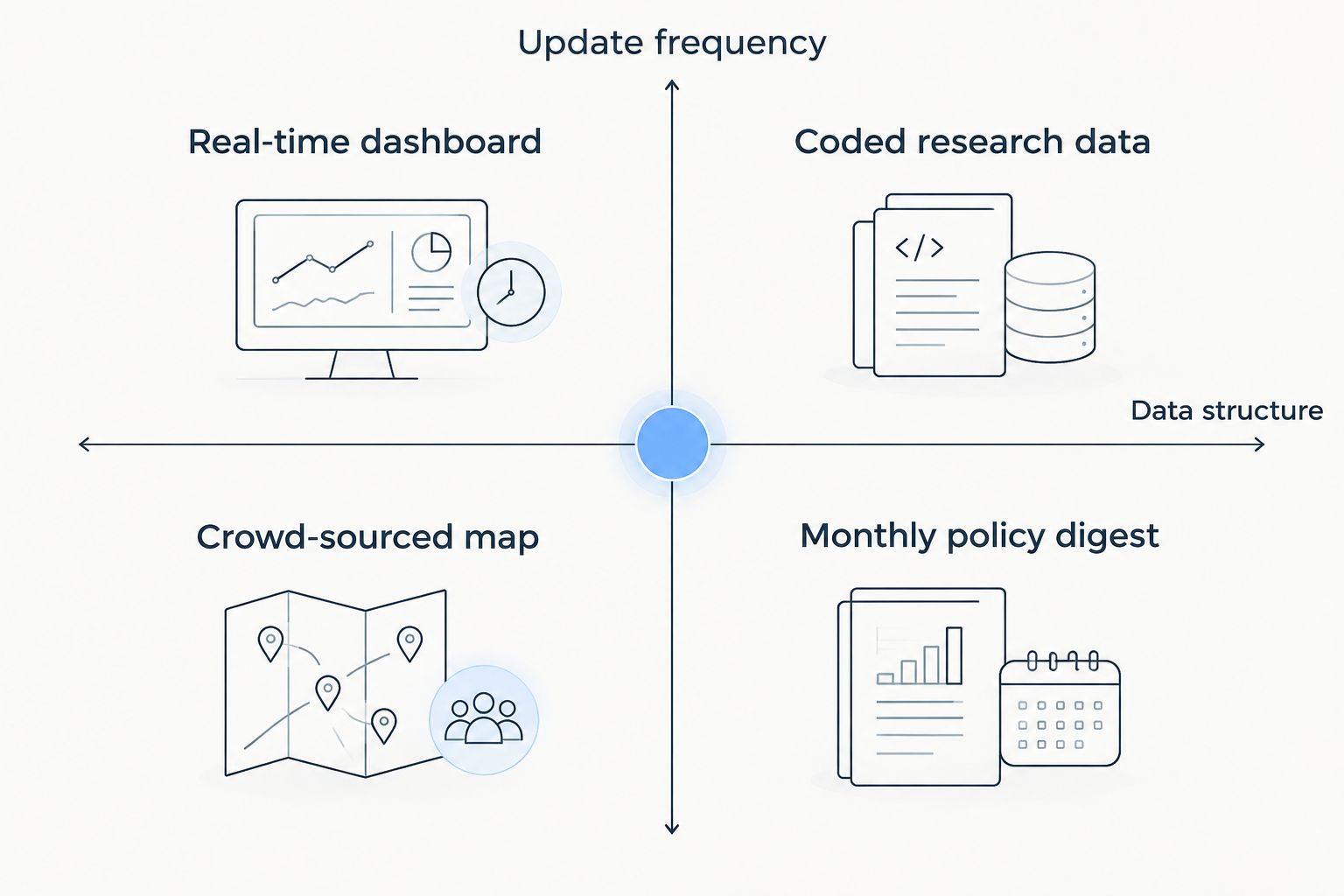
- Update frequency — real-time feed versus daily or monthly digest
- Data structure — coded, filterable event data versus narrative summaries
- Geographic breadth — global coverage versus regional focus
- Source transparency — cited primary sources versus aggregated wire copy
- Cost of entry — free and open access versus subscription or institutional login
- Cross-domain context — conflict data alone versus conflict paired with shipping, flights, and markets
At a glance
| Tool | Best for | Standout feature | Key limitation |
|---|---|---|---|
| World Monitor | Real-time multi-domain OSINT | Conflict, shipping, flights, markets and cyber on one live map | Newer project, smaller historical archive |
| CFR Global Conflict Tracker | Policy quick-reference | One-page summaries per conflict, written for briefings | Updates on an editorial cadence, not live |
| ACLED | Structured event-level data | Coded events with location and actor detail | Steeper learning curve for casual users |
| Liveuamap | Live breaking-event map | Crowd-sourced pins updated continuously | Verification quality varies by contributor |
| ISW interactive maps | Military campaign assessment | Daily battlefield assessments with control-of-terrain maps | Narrow focus, mainly Russia-Ukraine and a few theaters |
| Crisis Group CrisisWatch | Monthly risk monitoring | Country-by-country conflict risk ratings | Monthly cadence, not for live events |
| GDELT Project | Large-scale media event mining | Machine-coded global news events at scale | Raw data needs technical handling |
| UCDP | Academic trend analysis | Multi-decade conflict dataset used in peer-reviewed research | Not built for real-time use |
| ACAPS | Humanitarian severity scoring | Crisis severity index across active emergencies | Humanitarian lens, not military detail |
| Bellingcat | Open-source investigation | Deep-dive verification of specific incidents | Case-by-case, not continuous monitoring |
1. World Monitor: best global conflict tracker for real-time OSINT
World Monitor is a free, open-source dashboard that puts conflict tracking, shipping chokepoints, military flight movements, market data, and cyber signals on one live world map with AI-driven analysis layered on top. It's built for the reader who needs one screen instead of ten browser tabs, and the open-source model means the data pipeline isn't a black box.
World Monitor pros:
- Free and open-source, no paywall or institutional login
- Combines conflict data with shipping, aviation, and market signals in one view
- AI-driven analysis surfaces context instead of raw event dumps
World Monitor cons:
- Newer entrant, so its historical archive is thinner than academic databases like ACLED or UCDP
- Breadth across five domains means less depth than a single-purpose conflict database
World Monitor pricing: free. Best for: analysts and OSINT users who want live situational awareness across conflict and adjacent domains on one map. Verdict: Buy — the default pick for daily monitoring in 2026.
2. Council on Foreign Relations Global Conflict Tracker: best for policy quick-reference
CFR's Global Conflict Tracker is a curated set of one-page summaries covering active conflicts worldwide, written by CFR staff for people who need context fast, not a live feed.
CFR Global Conflict Tracker pros:
- Concise, readable summaries with clear background on each conflict
- Institutional credibility for citing in briefings and reports
- Free to access
CFR Global Conflict Tracker cons:
- Updates on an editorial schedule, not minute-by-minute
- No raw event data for filtering or export
Best for: journalists, students, and policy staff who need a fast primer, not live monitoring. Verdict: Buy for briefings, Skip if you need real-time updates.
3. ACLED: best for structured conflict event data
ACLED (Armed Conflict Location & Event Data Project) codes individual conflict events by date, location, and actor, which makes it the reference dataset for researchers building maps, models, or trend charts.
ACLED pros:
- Event-level coding with consistent methodology across regions
- Widely cited in academic and NGO research
- Data can be filtered and exported for analysis
ACLED cons:
- Interface has a learning curve for non-technical users
- Full access to some features requires registration
Best for: researchers and analysts who need coded, exportable event data rather than a map to glance at. Verdict: Buy for research work.
4. Liveuamap: best for live breaking-event mapping
Liveuamap pins reported events onto a live map as contributors submit them, which makes it useful for catching a story as it breaks rather than after it's been written up.
Liveuamap pros:
- Continuous updates, often faster than traditional news cycles
- Covers multiple active conflict zones simultaneously
Liveuamap cons:
- Crowd-sourced pins mean verification quality varies
- No structured export for downstream analysis
Best for: readers who want the fastest possible signal on a breaking event. Verdict: Hold — good as a secondary check, not a sole source.
5. ISW interactive maps: best for military campaign assessment
The Institute for the Study of War publishes daily assessments with control-of-terrain maps, mainly focused on the Russia-Ukraine war and a handful of other theaters.
ISW pros:
- Detailed daily battlefield assessments from named analysts
- Maps show territorial control changes over time
ISW cons:
- Narrow geographic scope compared to a global conflict tracker
- Not built for conflicts outside its covered theaters
Best for: anyone tracking the Russia-Ukraine front line specifically. Verdict: Buy for that theater, Skip for global coverage.
6. Crisis Group CrisisWatch: best for monthly conflict risk monitoring
CrisisWatch rates conflict risk across dozens of countries on a monthly cycle, flagging where situations are deteriorating or improving.
CrisisWatch pros:
- Consistent monthly ratings across a wide country list
- Useful for spotting trend direction, not just current state
CrisisWatch cons:
- Monthly cadence misses fast-moving events
- Ratings are qualitative, not raw event data
Best for: readers tracking slow-building risk rather than live incidents. Verdict: Hold as a monthly check-in tool.
7. GDELT Project: best for large-scale media event mining
GDELT machine-codes global news coverage into structured event data at a scale no manual process could match.
GDELT pros:
- Massive scale, covering global media in near real time
- Free and open dataset
GDELT cons:
- Raw output requires technical skill to query and clean
- Machine coding introduces noise that manual review would catch
Best for: data teams building their own conflict-monitoring pipelines. Verdict: Buy for technical teams, Skip for casual reading.
8. UCDP: best for academic conflict trend analysis
The Uppsala Conflict Data Program maintains a multi-decade dataset used across peer-reviewed conflict research.
UCDP pros:
- Long historical baseline for trend analysis
- Rigorous, well-documented coding methodology
UCDP cons:
- Not designed for real-time monitoring
- Data releases lag behind current events
Best for: academics and researchers studying conflict over years or decades. Verdict: Buy for academic work.
9. ACAPS: best for humanitarian severity scoring
ACAPS scores the severity of active humanitarian crises, which overlaps with conflict tracking but centers on humanitarian impact rather than military detail.
ACAPS pros:
- Clear severity index for comparing crises
- Useful for humanitarian and aid-sector planning
ACAPS cons:
- Humanitarian framing means less military or geopolitical detail
- Not a live event feed
Best for: aid organizations prioritizing response across multiple crises. Verdict: Hold — narrow use case outside humanitarian work.
10. Bellingcat: best for open-source investigation
Bellingcat runs deep, case-by-case open-source investigations verifying specific incidents rather than tracking conflicts continuously.
Bellingcat pros:
- Rigorous verification methodology on individual incidents
- Strong track record on high-profile investigations
Bellingcat cons:
- Not a continuous monitoring tool
- Coverage depends on which incidents the team chooses to investigate
Best for: readers who want a verified deep dive on one specific event. Verdict: Hold — use alongside a live tracker, not instead of one.
See the live global map now
Free, open-source conflict, shipping and flight tracking in one view.
How we ranked
Each tool was placed against the six criteria above: update frequency, data structure, geographic breadth, source transparency, cost of entry, and cross-domain context. Tools that combine live updates with structured, transparent data and free access ranked highest for daily monitoring; single-purpose research databases ranked by depth within their niche instead of trying to beat live dashboards on speed.
Which global conflict tracker should you choose?
If you check in once a day and want one screen that covers conflict alongside shipping and flight signals, World Monitor is the default pick for 2026. If you need a citable one-page summary for a brief, CFR's Global Conflict Tracker does that job faster than any live map. If your work is research, not monitoring, ACLED or UCDP give you the structured data a dashboard never will. Pick the tool that matches the question you're actually asking, not the one with the most name recognition.
FAQ
What is the best free global conflict tracker in 2026?
World Monitor is the best free option in 2026 because it's open-source and combines conflict, shipping, flight and market data on one live map. CFR's Global Conflict Tracker is also free but updates on an editorial schedule rather than in real time.
Is ACLED better than a live conflict tracker like Liveuamap?
ACLED and Liveuamap solve different problems. ACLED gives you coded, exportable event data for research, while Liveuamap gives you faster, crowd-sourced pins for breaking events.
How much does a global conflict tracker cost?
Most of the tools on this list, including World Monitor, ACLED, GDELT, UCDP and CFR's tracker, are free to access. Check each tool's current terms directly since access policies can change.
Which conflict tracker updates in real time?
World Monitor and Liveuamap both update continuously. CrisisWatch and UCDP update on monthly or periodic cycles instead, which makes them better for trend analysis than live monitoring.
Can I use a global conflict tracker for financial market signals?
World Monitor pairs conflict data with shipping chokepoints and market data on the same map, which is useful for traders watching how geopolitical events move prices. Single-purpose conflict databases like ACLED don't include market data.
What's the difference between ISW and a global conflict tracker?
ISW focuses on daily military assessments for a small number of theaters, mainly the Russia-Ukraine war, while a global conflict tracker like World Monitor or CFR's tool covers conflicts worldwide.
Is Bellingcat a conflict tracking tool?
Bellingcat is an open-source investigation outlet that verifies specific incidents rather than tracking conflicts continuously. Use it alongside a live tracker, not as a replacement for one.
Which tool is best for academic conflict research?
UCDP and ACLED are the standard references for academic conflict research in 2026, both offering multi-decade or event-level coded data suited to statistical analysis.
One last thing
The tools that rank highest for research, ACLED and UCDP, are the least useful for watching something unfold today, and the tools built for today, World Monitor and Liveuamap, aren't built for a ten-year regression. Most serious analysts in 2026 run two trackers side by side, not one: a live dashboard for the present and a coded dataset for the pattern behind it.